Free face shape finder + hairstyle ideas
7 Types of Face Shapes: Find Yours for Free
Find your closest face shape and get 2 hairstyle ideas with one selfie — completely free. Then explore the seven shapes and discover the colors that suit you.
Find My Face Shape — FreeFree face shape result + 2 hairstyle ideas. No account or credit card needed.
Find your face shape.
Get fresh hairstyle ideas.
Upload one clear selfie for your closest face shape, a short explanation and 2 hairstyle suggestions. All free.
- Your closest match among 7 face shapes
- 2 hairstyle ideas for your visible features
- No account or credit card needed
Face shapes blend into one another. Your result is a styling starting point based on this photo.
Seven outlines. A starting point for your style, with room to be yourself.
01 / The guide
7 Types of Face Shapes
The seven face shape types in this guide are oval, round, square, heart, diamond, oblong and triangle. Different face shapes can share features, so compare the whole outline, especially where your face is widest and how your jaw narrows.
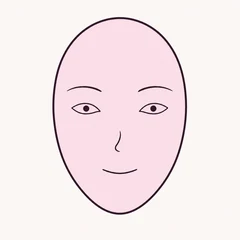
Longer than wide · softly tapered
Oval Face Shape
An oval face is a little longer than it is wide. The cheekbones are often the widest point, with a forehead and jaw that narrow gently rather than forming sharp corners.
- How to spot it
- Look for an even curve from the temples to the chin, with some extra length through the center of the face.
- Compared with similar shapes
- A round face has less visible length; an oblong face has a more noticeably elongated outline.
- A styling idea
- A center part reveals the outline; face-framing layers add movement around the cheeks.
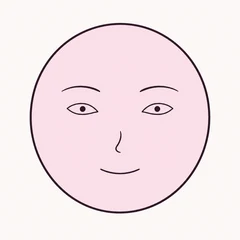
Similar length and width · curved jaw
Round Face Shape
A round face has similar length and width, with curved sides and a rounded jaw. The overall silhouette is soft rather than angular.
- How to spot it
- Compare hairline-to-chin length with cheekbone width. They look fairly close, and the jaw has no pronounced corners.
- Compared with similar shapes
- An oval face is more elongated. A square face may have similar proportions, but its jaw corners are clearer.
- A styling idea
- Long layers or an off-center part create diagonal lines; a rounded bob can celebrate the curved outline.
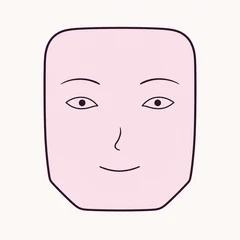
Even widths · defined jaw corners
Square Face Shape
A square face has a forehead, cheekbones and jaw that are fairly close in width. Straighter sides and defined jaw corners give the outline its characteristic shape.
- How to spot it
- Look at the lower third: the jaw stays broad before turning toward the chin, rather than tapering steadily.
- Compared with similar shapes
- A round face has a more curved jaw. A long face with similar angular features is often described as rectangular.
- A styling idea
- Soft waves create curved lines; a precise bob can draw attention to the jaw’s definition.
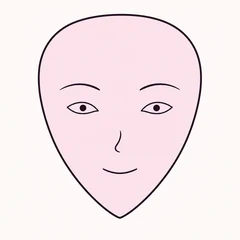
Broad forehead · narrow chin
Heart Face Shape
A heart-shaped face is broader across the forehead or upper face and narrows toward the jaw and chin. A widow’s peak may be present, but it is not required.
- How to spot it
- Compare the upper and lower face. The forehead looks broader than the jaw, and the chin is relatively narrow.
- Compared with similar shapes
- A diamond face is widest at the cheekbones and has a narrower forehead. A triangle face has the opposite width pattern.
- A styling idea
- A chin-length bob or waves near the jaw put the focus on the lower face.
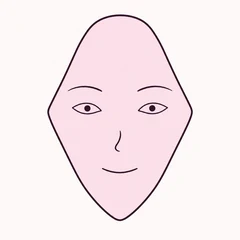
Wide cheekbones · narrow forehead
Diamond Face Shape
A diamond face is widest at the cheekbones, with a narrower forehead and jaw. The cheeks create the main change in direction along the outline.
- How to spot it
- Find the widest horizontal line: it falls across the cheekbones, while both the temples and jaw sit noticeably inside it.
- Compared with similar shapes
- A heart-shaped face has more width at the forehead. An oval face usually narrows more gradually around the cheekbones.
- A styling idea
- Tucking one side behind an ear highlights the cheekbones; soft layers frame them.
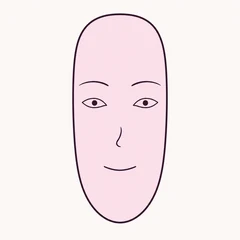
Noticeably long · fairly even widths
Oblong Face Shape
An oblong face has noticeably more length than width. The forehead, cheeks and jaw can be fairly similar in width, with rounded transitions along the outline.
- How to spot it
- Look for an extended hairline-to-chin distance and sides that stay fairly parallel instead of narrowing quickly.
- Compared with similar shapes
- An oval face has less pronounced length. A long face with angular jaw corners may be called rectangular; guides use these labels differently.
- A styling idea
- Bangs add a horizontal line; waves around the cheeks introduce width and movement.
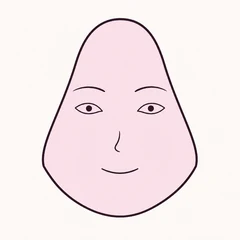
Narrow forehead · broad jaw
Triangle Face Shape
A triangle face, also called a pear-shaped face, is narrower at the forehead and broader at the jaw. This means the outline widens as you move downward.
- How to spot it
- Compare the temples with the jaw corners: the jaw is the broader part, rather than the forehead or cheekbones.
- Compared with similar shapes
- A heart face is an inverted triangle, widest at the top. A square face has less contrast between forehead and jaw width.
- A styling idea
- Texture near the temples adds interest to the upper face; a jaw-length cut can emphasize the lower outline.
02 / The guide
How to Determine Your Face Shape
Wondering “what face shape do I have?” A mirror, a clear view of your hairline and a few comparisons are enough to find a useful starting point.
Pull Your Hair Back
Use a headband or tie your hair back so you can see your natural hairline, temples and jaw. Face a mirror at eye level with a relaxed expression. If using a photo, keep the camera level and step back from a very close selfie, which can distort proportions.
Look at Your Forehead and Cheekbones
Compare the width of your forehead around the temples with the width across your cheekbones. Note which area looks widest. You can write down approximate measurements with a flexible tape, but the relative widths matter more than exact numbers.
Compare Face Length and Width
Look from the middle of your hairline to the bottom of your chin, then compare that distance with the width across your cheekbones. Similar dimensions suggest a round or square outline; more length points toward oval or oblong. There is no universal numerical cutoff.
Examine Your Jawline and Chin
Check whether the jaw is rounded, has visible corners or narrows toward the chin. A narrow chin alone does not separate heart from diamond: return to the forehead and cheekbones to see where the width sits. Combine all four observations before choosing a closest match.
Compare your outline, not the size of individual features. Hairlines, camera angles and facial expressions can change what you see. You do not need to fit one category perfectly.
| Shape | Widest area | Jaw & chin | Overall proportions |
|---|---|---|---|
| Oval | Usually cheekbones, with gentle narrowing | Rounded and softly tapered | A little longer than wide |
| Round | Cheeks or cheekbones | Curved, without strong corners | Length and width look similar |
| Square | Forehead, cheeks and jaw are close | Broad with defined corners | Length and width look similar |
| Heart | Forehead or upper face | Tapers toward a narrow chin | Upper face broader than lower face |
| Diamond | Cheekbones, distinctly | Narrow and tapered | Narrow at both the top and bottom |
| Oblong | Forehead and cheeks often close | Rounded or gently defined | Noticeably longer than wide |
| Triangle | Jawline | Broad, often clearly defined | Lower face broader than upper face |
03 / The guide
How to Tell Similar Face Shapes Apart
When two descriptions sound right, focus on the feature that separates them. Compare both illustrations with the same relaxed, front-facing view of your face.
Round vs Oval
Start with length, then follow the curve.
Both have rounded jawlines. In a round outline, cheekbone width is closer to overall face length. An oval outline has more length and a gentler taper toward the chin. Full cheeks alone do not make a face round.
Square vs Oblong
Compare proportions before jaw angles.
A square face has a compact outline and clear jaw corners. An oblong face is visibly longer. If yours is both long and angular, “rectangular” may describe it better than either label. Similar forehead and jaw widths can appear in all three.
Heart vs Diamond
Find the widest part of the upper face.
Both can have a tapered chin. A heart shape carries more width at the forehead or upper face; a diamond shape peaks at the cheekbones and narrows above them. A widow’s peak is not a reliable deciding feature.
Oval vs Oblong
Look for a gradual taper or parallel sides.
An oval face is moderately long, with a curved silhouette that gradually narrows. An oblong face has more pronounced length and often more parallel sides. If the distinction is subtle, use styling ideas from both instead of chasing an exact ratio.
04 / The guide
Best Hairstyles and Styling Tips for Each Face Shape
Use these ideas to explore a look you enjoy. When browsing face shapes for women or women’s haircuts, the same outline guide applies; texture, density, comfort and personal taste matter too. No shape needs to be corrected.
Oval
- Haircuts & texture
- Try a bob, a cropped cut or longer layers. Choose the length around your hair texture and how much time you enjoy spending on styling.
- Bangs & face framing
- Curtain bangs frame the eyes; a blunt fringe creates a stronger horizontal line.
- Glasses
- Try curved or angular frames to echo or contrast your features. Start with a width that feels comfortable across the temples.
Round
- Haircuts & texture
- Long layers introduce vertical movement. A chin-length bob or cropped cut can also highlight the fullness of the cheeks.
- Bangs & face framing
- Side-swept bangs add a diagonal; airy curtain bangs keep more of the forehead visible.
- Glasses
- Rectangular or geometric frames introduce angles. Round frames repeat the natural curves for a softer look.
Square
- Haircuts & texture
- Loose waves and textured layers create movement around the jaw. A sleek, blunt cut emphasizes its clean lines.
- Bangs & face framing
- A wispy or side-swept fringe creates a gentle diagonal; a straight fringe gives a more graphic look.
- Glasses
- Oval frames bring in curves. Angular frames can deliberately echo the definition of your jaw.
Heart
- Haircuts & texture
- A bob with movement near the chin emphasizes the lower face. A pixie or pulled-back style brings the upper face into view.
- Bangs & face framing
- Side-swept or separated curtain bangs frame the forehead without hiding it completely.
- Glasses
- Thin metal or softly rounded frames feel light; bolder frames make the eyes a focal point.
Diamond
- Haircuts & texture
- A tucked-back bob or a short textured cut puts the cheekbones in focus. Longer, loose layers frame that same area.
- Bangs & face framing
- A side fringe or curtain bangs introduce movement around the temples.
- Glasses
- Try oval, browline or subtly upswept frames. Check that the lower rim rests comfortably above your cheeks.
Oblong
- Haircuts & texture
- A shoulder-length cut with waves adds movement beside the cheeks. Sleek, long hair emphasizes the length of the outline.
- Bangs & face framing
- A full fringe or curtain bangs adds a horizontal break across the forehead.
- Glasses
- Frames with some lens depth create a clear horizontal focal point. Compare sizes in person for a comfortable fit.
Triangle
- Haircuts & texture
- Layers or texture near the temples bring attention upward. A simple, jaw-length bob draws attention to the jaw instead.
- Bangs & face framing
- A side fringe or textured bangs adds detail across the narrower forehead.
- Glasses
- Browline or cat-eye frames emphasize the upper face; minimal frames keep the overall effect understated.
The silhouette of a cut and its color answer different questions. Explore which hair colors suit your natural features when you’re ready to think about shades.
05 / The guide
Your Face Shape Is Just One Part of Your Personal Style
Your face shape can help guide hairstyles and accessories. But what about the colors that complement your natural features? Start with a free AI Color Analysis to discover your estimated color season and four colors to try.
Face Shape
- Hairstyle
- Glasses
- Face-framing styles
Color Analysis
- Clothing Colors
- Makeup Colors
- Hair Colors
- Seasonal Color Palette
Face shape describes proportions. Your color season is a separate part of your style.
No account or credit card needed.
A few more answers
Face Shape FAQs
Is the AI face shape finder free?
Yes. Upload one clear selfie to receive your closest face shape, two short observations and two hairstyle ideas for free. No account or credit card is needed. You can then choose a separate free Color Analysis; a complete color report is optional.
How does the face shape finder analyze my photo?
An AI vision model compares the visible face outline, upper face, cheekbones, jaw and chin. The result is a photo-based styling estimate, not a measured diagnosis. Camera angle, hair covering the forehead and lighting can affect it. Your photo is sent to our server and AI provider for analysis; this face shape tool does not save it.
What are the 7 main types of face shapes?
The seven common styling categories used here are oval, round, square, heart, diamond, oblong and triangle (also called pear). The names describe your overall outline. Some guides use six categories or include rectangular faces separately, so the lists are not universal.
How can I identify my face shape?
Pull your hair back and look straight into a mirror. Compare your forehead, cheekbone and jaw widths, then compare your face length with its width. Finally, look for a curved, angular or tapered jaw. Choose the closest overall pattern; a single feature is rarely enough.
What is the most common face shape?
Oval is often described as common in styling guides, but there is no single population-wide ranking used here. Classification methods and the people being described vary. You do not need a prevalence statistic to compare your own proportions.
Can your face shape change over time?
Your visible outline can change as you grow and age or as facial fullness changes. Hairstyling and camera perspective can also make the same face appear different. Treat a face shape label as a current styling reference rather than a permanent identity.
Can you have a combination of two face shapes?
Yes. You might have the length of an oval face with the defined jaw of a square face, for example. These categories simplify a continuous range of features. Borrow styling ideas from either description and keep the ones that feel like you.
Is face shape related to seasonal color analysis?
They are different styling dimensions. Face shape concerns outline and proportions; seasonal color analysis considers the colors of your natural features. You cannot tell whether someone is Spring, Summer, Autumn or Winter from their face shape. Our selfie tool provides color analysis, not face shape detection.
Are face shape types different for women and men?
The same broad shape categories can describe anyone. A guide to face shapes for women may focus on different hairstyle examples, but the proportions used to describe the shapes are the same. Hair texture, preferred haircut, frame fit and individual proportions are more useful than treating the labels as gender rules.
Further reading: Warby Parker’s face shape and frame guide and L’Oréal Paris on identifying face shapes. Categories vary between guides; the illustrations and explanations on this page are original.
Find Your Best Colors for Free
Upload a selfie to get your estimated color season, four recommended colors, and an outfit preview for free.
Try Free AI Color AnalysisNo account or credit card needed. A full report is optional.