Color season analysis
What Color Season Am I?
Color season analysis sorts natural coloring into families that share the same temperature, depth and clarity. Your color season is simply the family whose palette sits most comfortably next to your skin, hair and eyes.
Start with the four main seasons, narrow to one of twelve, and use the three-question check below to see where you probably land.
- 4 main seasons
- 12 sub-seasons
- 16-season variants
- 3 questions
Self-check
What season am I? Three quick questions
Answer in natural daylight, without makeup if you can. The 12-season system names each season after its strongest trait, so the second question matters most.
Answer the first two questions. A third appears when your strongest trait is warmth or coolness.
A self-check gives a starting point, not a diagnosis. Lighting, hair dye and screen color all shift what you see.
The method
How seasonal color analysis works
Every color can be described by three properties: hue (warm or cool), value (light or dark) and chroma (clear or muted). Seasonal color analysis applies the same three properties to a person. Skin undertone, hair color and eye color are read together, and the season is the palette whose colors repeat those qualities.
Spring and Autumn are the warm seasons; Summer and Winter are the cool ones. Spring and Summer are lighter, Autumn and Winter deeper. Spring and Winter are clear and saturated, Summer and Autumn soft and muted. That is the whole four-season system in one paragraph.
The 12-season system keeps the four families but splits each into three by the trait that dominates. A Soft Autumn is an Autumn whose most visible quality is softness; a Deep Winter is a Winter whose most visible quality is depth. Each sub-season borders a neighboring family, which is why Soft Autumn and Soft Summer — or Deep Autumn and Deep Winter — are so often confused.
- Hue: does gold or silver, cream or white, sit better next to your face?
- Value: are your features light, medium or deep overall?
- Chroma: do saturated colors look sharp on you, or do muted colors look more natural?
4 → 12
The 12 color seasons at a glance
The inner ring shows the four main seasons; the outer ring shows each one divided into three sub-seasons. Select a segment to open that season’s palette.
Directory
Seasonal color palettes: all 12 seasons
Each guide includes an original palette with HEX codes, outfit formulas, colors to wear with care and notes on hair and makeup.
- Spring
Light Spring
Light, warm & delicate
Read the guide - Spring
True Spring (Warm Spring)
The warmest, sunniest Spring
Read the guide - Spring
Bright Spring (Clear Spring)
Saturated, warm & electric
Read the guide - Summer
Light Summer
Airy, cool & pastel
Read the guide - Summer
True Summer (Cool Summer)
The coolest, most classic Summer
Read the guide - Summer
Soft Summer
Muted, cool & smoky
Read the guide - Autumn
Soft Autumn (Soft Fall)
Muted, warm & gentle
Read the guide - Autumn
True Autumn (Warm Autumn)
The warmest, spiciest Autumn
Read the guide - Autumn
Deep Autumn (Dark Autumn)
Deep, warm & rich
Read the guide - Winter
Bright Winter (Clear Winter)
Icy, vivid & high-contrast
Read the guide - Winter
True Winter (Cool Winter)
The coolest, crispest Winter
Read the guide - Winter
Deep Winter (Dark Winter)
Dark, cool & dramatic
Read the guide
Four seasons
Spring, Summer, Autumn and Winter compared
If you only remember one thing: Spring is warm and clear, Summer cool and soft, Autumn warm and muted, Winter cool and vivid.
Contrast
High contrast vs low contrast coloring
Contrast is the difference in lightness between your hair, skin and eyes. It does not decide your season on its own, but it explains why two people in the same season wear color differently.
| Contrast level | What it looks like | How to dress it | Often seen in |
|---|---|---|---|
| High contrast | Dark hair with light skin, or very bright eyes against deep hair. A high contrast face reads clearly in black-and-white photos. | Pair light and dark pieces together; crisp black and white, bold lips and saturated accents hold their own. | Bright Winter, True Winter, Bright Spring |
| Medium contrast | Some separation between features, but nothing stark — for example medium brown hair with medium skin. | Two-tone outfits with a moderate gap in lightness; a defined but not dramatic lip. | True Autumn, True Summer, True Spring |
| Low contrast | Hair, skin and eyes sit close in lightness. A low contrast face looks blended rather than outlined. | Tonal dressing — shades of one color family. Low contrast makeup in sheer, blended layers. | Soft Summer, Soft Autumn, Light Spring |
Quick test: take a selfie, switch it to grayscale and squint. If your features blur together, you are lower contrast; if hair and eyes still stand out sharply, you are higher contrast.
For men
Color seasons for men
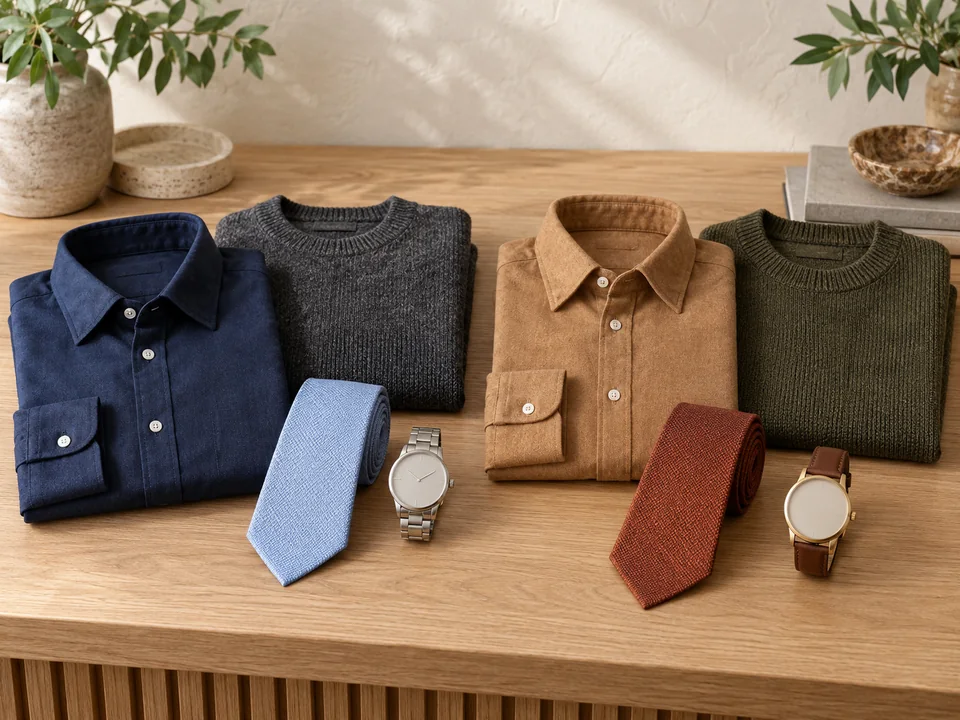
Seasonal color analysis works the same way for men; it just shows up in different places. Most of the color near a man’s face comes from shirts, knitwear, ties, outerwear and frames, so the season mainly decides the neutrals of a wardrobe.
Warm seasons look sharper in camel, olive, warm navy, chocolate and cream. Cool seasons look sharper in charcoal, blue-gray, true navy and soft or pure white. A Winter man can wear a black suit with a white shirt easily; an Autumn man usually looks better in brown, olive or a navy with warmth in it.
Beard and stubble color count as part of your hair coloring, and gray hair usually shifts a palette slightly cooler and softer over time.
Celebrities
Celebrity examples by season
Celebrities help to visualize a season, but hair dye, lighting and makeup change from photo to photo. Use them as a reference for the overall impression, not as proof.
Soft Autumn
Often cited: Gisele Bündchen, Drew Barrymore, Jennifer Aniston — golden but gentle, nothing harsh.
Read the guideSoft Summer
Often cited: Kate Middleton, Sarah Jessica Parker, Taylor Swift — cool, muted and blended.
Read the guideDeep Winter
Often cited: Lucy Liu, Anne Hathaway, Selena Gomez — dark hair, clear eyes, striking contrast.
Read the guideDeep Autumn
Often cited: Eva Mendes, Jessica Alba, Julia Roberts — deep and warm with rich hair.
Read the guide
Celebrity seasons are based on public photos and widely shared opinions, not official analyses.
Commonly confused
Seasons that are easy to mix up
Soft Autumn vs Soft Summer
Both are muted and medium; the difference is a small shift in temperature.
Read the guideDeep Autumn vs Deep Winter
Both are dark; one leans golden and rich, the other icy and vivid.
Read the guideThe 16-season system
Where Soft Spring, Soft Winter and the other extra seasons fit.
Read the guide
Frequently asked questions
Short answers to the questions people ask most about this topic.
What is color season analysis?
Color season analysis groups natural coloring into seasons — Spring, Summer, Autumn and Winter — based on undertone, depth and clarity. Each season has a palette of colors that share those qualities and tend to look harmonious near the face.
How do I know what color season I am?
Compare warm and cool colors near your face in daylight, notice whether light or deep, clear or muted colors look more natural, and match that combination to a season. The three-question check on this page does exactly that; a photo-based analysis can add an outside estimate.
What is the difference between 4, 12 and 16 color seasons?
The four-season system uses Spring, Summer, Autumn and Winter. The 12-season system splits each into three sub-seasons by the dominant trait, such as Light, Soft or Deep. Some 16-season systems add four more blends, like Soft Spring or Soft Winter. Our free photo analysis returns one of the four main seasons; the 12 and 16 seasons are reference content.
Can your color season change?
Your natural coloring is fairly stable, but tanning, hair dye and graying can shift which colors look best. Many people move slightly lighter or softer with age; re-check if your hair color changes a lot.
Is seasonal color analysis accurate?
It is a styling framework, not a scientific measurement. It is most useful as a way to understand why some colors flatter you. Results depend heavily on lighting, so compare colors in daylight and look for patterns rather than one decisive swatch.
Do color seasons work for men?
Yes. The method is the same; men usually apply it to shirts, knitwear, suits and outerwear, where the right neutrals make the biggest difference.
What season has the most people?
There is no reliable census of color seasons. Medium, muted seasons such as Soft Autumn and Soft Summer are frequently reported, partly because many people have blended, medium-contrast coloring.
See which season your photo points to
Upload a clear, front-facing selfie in daylight. The free analysis estimates one of the four main seasons and shows four colors to start with.
Upload a selfieFree analysisNo account needed